Safe Schools Protocol
For teachers and school staff — recognizing online harms and self-harm signals, creating environments where students speak up, and coordinating with families.

Meet Ms. Rachel Carter
Ms. Carter has taught 8th grade English at Watauga High's feeder middle school for eleven years. She is the teacher students come back to visit. She is also the teacher who noticed something was wrong with Maya — before anyone else did.
This course follows Ms. Carter through two situations that unfolded in a single school year: Maya's online harm case and Tyler's self-harm signals. Neither fit neatly into the training she had received. Both required her to draw on judgment, school relationships, and a willingness to act.
The goal of this course is to give you the same foundation — practical, honest, and grounded in what actually happens in classrooms like yours.
What This Course Covers
The actual digital landscape of 8th graders — platforms, behaviors, and what teachers can and cannot see
Online harms in the classroom context: grooming, exploitation, cyberbullying — the behavioral signals that appear at school
Self-harm and online content — how digital environments accelerate risk and what you are positioned to notice
Building a classroom where students feel safe enough to speak up — language, environment, and response protocol
Coordinating with families — when to call, what to say, how to navigate parents who are scared, skeptical, or in denial
Documentation, reporting pathways, and your role in the school's coordinated response
Maya — 8th grade, quiet, high-achieving. Something changed in October. Tyler — gregarious in September, increasingly withdrawn by November. Neither story ends the way you might expect. Both contain things teachers wish they had known sooner.
Module 3 addresses self-harm, suicide risk, and online communities that encourage both. The content is clinical and practical. It is here because this is what you will encounter — and what you need to be prepared for. This course is for educators, not students.
The 8th Grade Digital World
What their online lives actually look like — and the gap between what you see in class and what is happening on their screens.

"I asked my class on the first day how many of them were on TikTok. Every hand went up. How many had Discord? About half. Instagram? Almost all of them. I then asked how many of their parents knew which accounts they used. Maybe six hands. I have been teaching for eleven years and that number still surprises me every time."
The Invisible Layer
When a student walks into your classroom, they bring their digital life with them — in their pocket, in their emotional state, in the undercurrent of whatever happened in the group chat last night. Understanding that layer is not about surveillance. It is about being positioned to notice when something is wrong.
What 8th Graders Are Actually Using
- TikTok: Primary platform for most 13–14 year olds. Algorithm is powerful and highly personalized — a student struggling with self-worth will be served content that amplifies that. A student exploring risk-taking will find communities built around it within hours.
- Instagram: Persistent for image-based identity performance. Stories and DMs are where relationships — and exploitation — frequently develop. "Finsta" (fake/private accounts) are common and specifically designed to hide content from parents.
- Snapchat: Ephemeral messaging — the perception that images disappear makes students more willing to share things they would not otherwise share. Screenshots are common. This is a primary vector for sextortion targeting.
- Discord: Organized around interests and gaming. No age verification. Private servers are invisible to parents. This is where many 8th grade students have their most meaningful online peer relationships — and where bad actors have learned to look.
- Roblox / Minecraft / gaming servers: Still active at this age group, particularly for boys. In-game communication with strangers is frequently enabled. Voice chat in particular removes the distance that text creates.
- Reddit / Tumblr: Less visible to parents but significant for 8th graders seeking community around identity, mental health, and taboo interests. Pro-self-harm and pro-eating-disorder content is organized and searchable here.
Each of these platforms also hosts genuine community, creativity, and connection — things 13-year-olds need. The goal is not blanket restriction. It is understanding where risk concentrates so you can recognize its signals in the room.
What You Can and Cannot See
As a classroom teacher, your field of view is real but narrow. You see a student for 50 minutes a day. You see their work, their body language, their social dynamics with the students around them. You do not see what is on their phone. You do not see what happened at 11pm.
What you do see — that no one else consistently sees — is behavioral baseline. You know when a student's writing changes tone. You know when an usually engaged student stops making eye contact. You know when two friends stop sitting together without explanation.
That baseline knowledge is one of the most powerful early-warning instruments available in a school. This course is about helping you use it.
The 8th Grade Risk Profile
13 and 14 year olds occupy a specific developmental window that makes online harm both more likely and more impactful than at almost any other age:
- Identity formation is in full force. Peer validation online carries genuine developmental weight — rejection or humiliation in digital spaces is not "just the internet" to a 13-year-old.
- Parental oversight has typically loosened relative to elementary school — students have more device independence — while adult judgment is not yet developed.
- The gap between digital fluency and digital wisdom is widest at this age. Students navigate complex platforms with ease while lacking the emotional scaffolding to process what they encounter there.
- Social hierarchies are actively contested. Status anxiety at this age makes students more vulnerable to flattery, to belonging-seeking in online communities, and to poor decision-making when acceptance feels at stake.
Reflection: Your Classroom Baseline
Check what you already know about your students' digital livesThese items are not a performance measure — they orient you to the areas this course will strengthen.
Module 1 Check-In
1. "Finsta" accounts are significant for educators primarily because:
2. As a classroom teacher, your most valuable observational asset is:
3. Discord is a particular concern at the 8th grade level because:
Recognizing Online Harms
Grooming, exploitation, coercion, and cyberbullying — what the signals look like from a classroom seat.
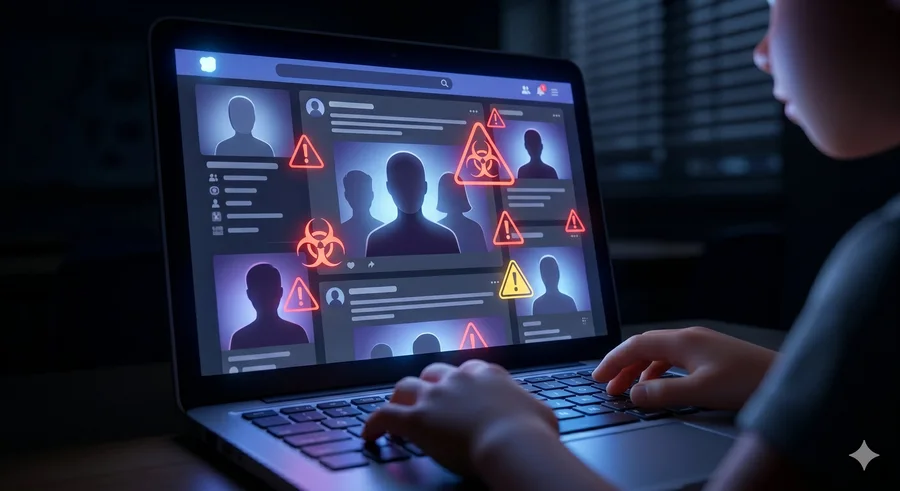
"She had always been the student who turned everything in early. By October she was missing assignments — not dramatically, just quietly. She sat in the same seat but she felt farther away. I could not explain it and I almost didn't act on it because I couldn't explain it."
What Online Harm Looks Like in Your Room
Online harms rarely present as obvious crisis events in the classroom. They present as drift — a gradual change in a student's engagement, mood, or social behavior that accumulates over weeks. By the time the situation is urgent, the drift has been happening for a long time.
Grooming: The Classroom Signals
Grooming is methodical. A bad actor builds trust with a student over time — often weeks or months — before any overt harm occurs. The behavioral signals visible to a teacher typically begin to appear mid-process:
- Student appears distracted, mentally elsewhere — not typical adolescent distraction but a quality of absence
- Increased phone use or anxiety around phone availability — checking it with an urgency that is disproportionate
- Withdrawal from usual peer group — new social distance from friends they previously seemed close to
- Written work shifts tone — essays or journal entries become darker, more preoccupied with themes of secrecy, loyalty, or adult relationships
- Gifts, new accessories, or unexplained money — gaming credits, gift cards, small items they did not have before
- Defensiveness or anxiety when asked direct questions — about what they are doing, who they are talking to
Sextortion: What Teachers Need to Know
Sextortion — the coercion of young people through intimate images — has increased dramatically and the average age of targets is dropping. 8th grade students are squarely in the target range. The behavioral profile is distinct:
- Acute, sudden change — not gradual drift but a sharp behavioral shift that appears to have a specific onset date
- Intense anxiety or panic that the student cannot or will not explain
- Avoidance of devices in some students; compulsive device use in others (compliance with demands)
- Expressions of hopelessness, shame, or statements that feel more final than typical adolescent frustration
Research links sextortion victimization in adolescents with acute suicide risk. If you observe the sudden acute shift described above — particularly combined with statements suggesting hopelessness — escalate immediately to your school counselor. Do not wait for confirmation of what happened. Speed matters. Contact 988 or your school crisis protocol.
Cyberbullying: Beyond the Screen
Cyberbullying presents in the classroom through social dynamics as much as individual behavior. Watch for:
- Sudden social exclusion — a student who was part of a group is visibly frozen out
- Clusters of students who go quiet or shift behavior when a specific student enters the room
- Laughter or phone-sharing behavior with a specific student as the obvious subject
- A student who flinches, shows anxiety, or checks their phone compulsively after any social interaction
- Written work referencing being "talked about," "left out," or feeling "everyone knows"
The Writing as Signal
As an English teacher, Ms. Carter had access to something most teachers do not — Maya's written voice. In September it was clear and confident. By October it had changed: more passive constructions, themes of obligation and secrecy, a journal entry about a character who "had to keep a promise even when it hurt."
Student writing is one of the most reliable windows into their interior life. It is not a diagnostic tool — and you should not treat it as one. But a sustained shift in a student's written tone, combined with other behavioral changes, is worth noting and worth talking to your counselor about.
Activity: Concerning or Explainable?
Apply your professional judgment to each classroom observationObservation A
A typically engaged student misses two assignments in a row. When you ask, she says she forgot. Her grade has been consistent for two years.
Observation B
A student who is normally talkative is quiet for the third week in a row. Her friends do not seem to be including her. She eats alone. She has started wearing long sleeves in warm weather.
Observation C
You notice a cluster of students sharing a phone and laughing. When a specific student walks in, the group goes quiet and puts the phone away. This has happened twice this week.
Observation D
A student writes a short story for class about a girl who meets someone online who "understands her like no one in her real life does." The story ends ambiguously. The student's behavior is otherwise unchanged.
Module 2 Check-In
1. Online harm typically presents in the classroom as:
2. The acute behavioral shift associated with sextortion is significant because:
3. A student's writing is a useful observational tool because:
Self-Harm & the Online Link
How online content accelerates self-harm risk — and what you are positioned to notice before the crisis escalates.
This module addresses self-harm and suicide risk directly. If a student in your class is in immediate danger: call 911 and follow your school's crisis protocol. Resources to have on hand: 988 Suicide & Crisis Lifeline — call or text 988. Crisis Text Line — text HOME to 741741. Trevor Project (LGBTQ+ youth) — 1-866-488-7386 or text START to 678-678. This course content is educational only — not a crisis response guide.
"Tyler had been one of the loudest voices in my classroom in September. By November he was barely there. I told myself it was just the November slump — every teacher knows it. Then I found something in his journal that made me realize I had been explaining away something I should have noticed weeks earlier."
The Online-Self-Harm Connection
Research consistently shows a bidirectional relationship between self-harm and online content exposure. Young people who are struggling seek out online communities that validate their feelings — and those communities, while sometimes offering genuine support, also normalize, romanticize, and in some cases instruct self-harm behaviors.
How Algorithms Accelerate Risk
Platform recommendation algorithms are designed to maximize engagement — they surface content that produces the strongest emotional response. For a 13-year-old experiencing depression, anxiety, or hopelessness, this means the algorithm will efficiently surface communities organized around those feelings. The content escalates. What begins as relatable sadness posts becomes increasingly explicit self-harm content within hours of first engagement.
- TikTok: Self-harm and suicide-related content circulates using coded language designed to bypass content filters — spellings like "unalive," community hashtags that shift frequently to avoid detection
- Reddit and Tumblr: Longer-form communities organized explicitly around self-harm — some with detailed instructional content
- Discord: Private servers where self-harm is discussed and sometimes encouraged in real time, with members holding each other accountable to behaviors
- Instagram: "Soft" self-harm content — imagery of bruises, injuries, poetry romanticizing pain — is common and increasingly visible in feeds of struggling students
Social contagion of self-harm and suicidal behavior among adolescents is well-documented. When one student in a close peer group engages in self-harm — particularly when it is visible online within the group — risk increases for others in that network. This is not about blaming students for influencing each other. It is about understanding that one disclosure in your classroom may indicate risk for others in that social group.
Classroom-Level Warning Signs
Self-harm rarely announces itself. What you are looking for is a constellation of signals over time, not a single indicator:
Physical
- Clothing inconsistent with weather — long sleeves in warm rooms, refusal to change for PE
- Visible marks on arms, legs, or wrists (cuts, burns, bruising in linear or repetitive patterns)
- Flinching at contact with sleeves or when asked to reach for something
- Bandages or adhesive strips that are covered or explained dismissively
Behavioral
- Progressive withdrawal from classroom participation over weeks
- Loss of investment in work from a previously engaged student
- Written work that references pain, numbness, self-hatred, or themes of "disappearing"
- Giving away possessions — books, small items — without a clear reason
- Statements that feel more permanent than the situation warrants: "It doesn't matter anyway," "I won't have to deal with this much longer"
- Sudden calm after a period of distress — sometimes indicates a decision has been made
A student who has been visibly distressed for weeks and then appears at peace — without apparent reason — can be one of the most serious signals in this list. In some cases it reflects genuine improvement. In others it reflects a decision that has resolved the student's internal conflict in a dangerous direction. If you see this: talk to your counselor the same day.
What To Do and What Not To Do
When You Suspect
You do not need certainty before you act. You need concern. Your role is not to diagnose or confirm — it is to notice and hand off to the right person with the right information.
Talk to your school counselor. That conversation does not commit you to any particular course of action. It surfaces your concern to someone trained to assess it. Document what you observed — specific behaviors, dates, quotes from student work — before the conversation so the counselor has your baseline data.
- Staying calm and not visibly alarmed — your regulation matters for the student's sense of safety
- Asking open, non-leading questions: "I noticed you seem like you have a lot on your mind. Are you doing okay?"
- Saying clearly: "I am not going to get you in trouble for telling me the truth"
- Connecting them to the counselor yourself — walking them there rather than just sending them
- Asking "Are you thinking about hurting yourself?" in a public space — this should happen in private
- Promising confidentiality you cannot legally keep
- Minimizing: "I'm sure it's not that bad" or "You have so much to live for"
- Notifying parents before the counselor is involved — in some family situations, this can increase risk
- Leaving a student alone if you believe the risk is immediate
Module 3 Check-In
1. Platform recommendation algorithms increase self-harm risk because:
2. The "sudden calm" signal is significant because:
3. Before contacting parents about a student you are concerned about, you should:
Classrooms That Speak Up
Language, environment, and response — building the conditions where students feel safe enough to tell you something difficult.
"Maya told me later that she had wanted to say something for three weeks before she did. She said the reason she finally told me was that I had once told the whole class: 'You will never be in trouble for telling me the truth about something hard.' She remembered that. I had said it once, at the start of the year, and forgotten I said it. She had held onto it."
The Disclosure Climate
Students do not disclose to adults who seem busy, distracted, judgmental, or likely to overreact. They disclose to adults they have reason to believe will stay calm, will not immediately escalate in ways that feel out of their control, and who have demonstrated — through small consistent acts — that they are trustworthy.
Building a classroom where students can speak up is not a single lesson or a poster on the wall. It is a climate established through dozens of small choices across a school year.
Language That Opens Doors
- "You will never be in trouble for telling me something hard." — Say this explicitly. Say it early. Repeat it.
- "I am not going to pretend I didn't notice." — Normalizes the act of observation without creating threat.
- "I might need to talk to someone else who can help better than I can — but I will always tell you before I do." — Addresses the control concern that often prevents disclosure.
- "You don't have to tell me everything. You can tell me just enough that I know you need support." — Lowers the threshold for partial disclosure.
Language That Shuts Doors
- "Why didn't you say something sooner?" — induces shame, discourages future disclosure
- "I promise I won't tell anyone." — a promise you legally cannot keep, and which will damage trust when broken
- "Are you sure? That sounds serious." — signals doubt and increases the student's doubt about whether to continue
- "I'm sure it's not that bad." — minimizes and ends the conversation
The First 90 Seconds
When a student discloses — whether it's a sentence or a paragraph — how you respond in the first 90 seconds determines whether they continue or shut down. Three things matter above all:
- Stay in your body. Do not let visible shock, distress, or urgency read on your face. Your regulation is their signal that this is survivable.
- Acknowledge before you act. "Thank you for telling me" before anything else. Not "okay let's go to the counselor right now." Acknowledgment first.
- Tell them what happens next — before it happens. "I need to tell our school counselor about this. I am going to walk over there with you right now." Agency, information, companionship.
Your role when a student discloses is not to fix what is happening. It is to receive the disclosure with enough care that the student remains connected to the process — and then to hand off to the right professional with the right information. Being the bridge is significant. Do not underestimate it.
Response Lab: The Disclosure Moment
Maya stops you after class. Choose your response.Maya lingers as the other students file out. You are gathering your papers. She says quietly: "Ms. Carter, something has been happening and I don't really know what to do about it. There's someone online who I have been talking to and it feels weird now but I don't know if it's a big deal."
You have 30 seconds before the next class arrives.
Classroom Climate Self-Audit
Check what is true of your classroom environment right nowModule 4 Check-In
1. In the first 90 seconds of a student disclosure, the most important thing to do first is:
2. Promising a student confidentiality is problematic because:
3. Your core role when a student discloses is:
Coordinating with Families
When to call, what to say, and how to navigate parents who are scared, skeptical, or not ready to hear it.

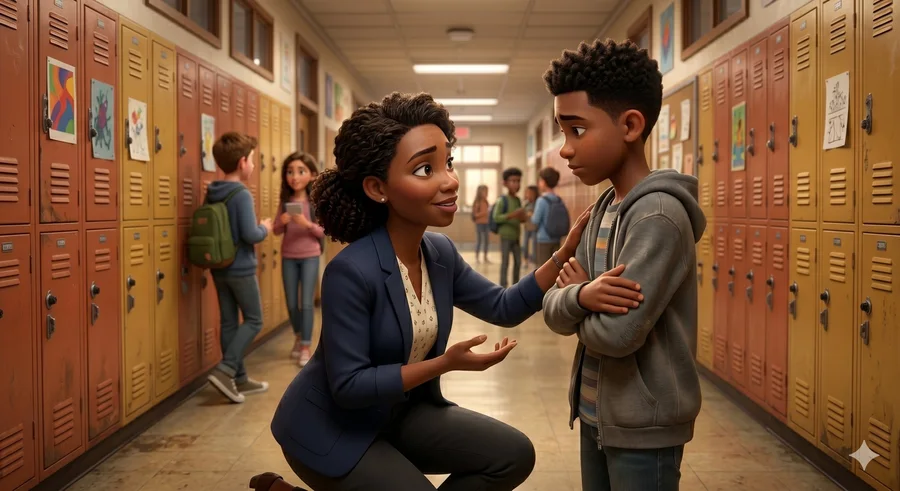
"Her mother cried immediately. Her father's arms went across his chest. He looked at me like I was the problem. I had seen that look before. I kept my voice level and I kept saying 'I am here because I want Maya to be safe and I need your help to do that.' By the end of the meeting he was the one asking what they could do. It took forty minutes to get there."
Before You Call
The decision to involve a family should happen in coordination with your school counselor — not unilaterally. In some situations (suspected abuse at home, certain mental health crises), involving parents prematurely can increase risk. Always loop in your counselor before a family contact around safeguarding concerns.
Once the decision is made to involve the family, preparation matters:
- Know specifically what you observed — not what you suspect, not what the student told you was its cause. Your lane is behavioral observation.
- Know what the school's next steps are before you make the call — parents will ask, and an uncertain answer creates doubt about whether the school is handling this competently.
- Have the counselor on the call or in the room if possible. You are the relationship; they are the expertise.
You observed. You reported. You are following up with the family as part of a coordinated response. You are not diagnosing their child, predicting outcomes, or prescribing actions. Stay in your lane — it protects you, it protects the student, and it protects the family relationship you will need to maintain after this conversation.
The Parent Meeting: Common Scenarios
The Scared Parent
Tears, visible distress, "I had no idea." This parent is ready to help — they need direction and calm. Give them specific, actionable steps. Tell them what the school is doing. Let them know who their point of contact is going forward. Do not overwhelm with information in the first meeting.
The Defensive Parent
Arms crossed, skeptical, "Are you sure this isn't a misunderstanding?" or "My child would tell me." This is not a hostile parent — this is a scared parent who is protecting themselves from something they are not ready to face. Your job is not to win the argument. It is to keep returning to shared interest: "I know you want Maya to be safe. That is exactly why I called." Specific observations — dates, direct quotes from student work, behaviors you witnessed — carry more weight than general concern.
The Minimizing Parent
"Kids these days are so sensitive," or "He's just going through a phase." Name the concrete evidence calmly and do not retreat from it. "I understand it might look like that. What I can tell you is that I have been teaching for eleven years and what I observed over three weeks with Tyler is not typical for him. I needed to make sure you knew." Then document the conversation.
The Overwhelmed Parent
Already dealing with significant family stress, financial pressure, or their own mental health challenges. This parent may not have capacity for the full conversation in one meeting. Identify the single most important action item and focus there. Connect them to school social work resources if available.
Response Lab: The Defensive Father
Tyler's father is across the table. Choose your response.Tyler's father says: "I don't understand why we're here. Tyler has always been a little quiet — that's just who he is. I think maybe you're reading too much into this. He seems fine to me at home."
Module 5 Check-In
1. Before contacting a student's family about a safeguarding concern, you should:
2. When a parent is defensive and minimizing, the most effective approach is:
3. In a family meeting your role as classroom teacher is:
Reporting & Documentation
Your role in the school's coordinated response — what to document, when mandatory reporting may apply, and how to hand off effectively.
Documentation: Why It Matters and How to Do It
Effective documentation serves three purposes: it provides the school counselor and administration with accurate baseline data, it protects you professionally if your concern is later questioned, and it creates a record that can be critical if the situation escalates to formal reporting or legal involvement.
What to Document
- Specific observations — not interpretations. "Student wore long sleeves on four consecutive warm days and flinched when her sleeve was touched" — not "I think she is self-harming."
- Dates and times — precise, contemporaneous. Document the day you observe, not a week later.
- Direct quotes — if a student says something concerning, write it down as close to verbatim as possible, with the date and context.
- Student work samples — retain copies of written work that you flagged as concerning. Note when you retained them and why.
- Actions taken — who you spoke to, when, what was said. This is your record of having followed protocol.
Student documentation belongs in your school's official systems. If your school provides a platform for concern notes (safeguarding logs, student information systems), use them. If not, written records kept in your school filing system are appropriate. Personal cloud accounts or home devices create privacy and security risks — and may not be admissible in the way school records are.
Mandatory Reporting: What Teachers Need to Know
Most states designate teachers as mandatory reporters — meaning you may have a legal obligation to report suspected child abuse, neglect, or exploitation directly to child protective services or law enforcement, independent of your school's internal process.
Mandatory reporting laws vary significantly by state — what triggers the obligation, the timeline, who must report, and the consequences for failure to report all differ. This course covers the concept in general terms only. Know your state law and know your district policy before you need them.
Resources to Know Your Obligations
- RAINN State Law Database — rainn.org/laws — searchable by state, covers reporting requirements, penalties, and definitions
- Child Welfare Information Gateway — childwelfare.gov — federal resource on mandatory reporting by state
- Your district's legal counsel or HR department — the authoritative source for your specific employment context
- Your school principal or vice principal — should be able to direct you to your school's protocol
- NCMEC CyberTipline — CyberTipline.org or 1-800-843-5678 — for suspected online exploitation of a minor
Most state mandatory reporting laws include good-faith protections for reporters — if you report in good faith and the concern turns out not to be substantiated, you are generally protected from liability. The professional and legal risk of failing to report when you should have is significantly greater than the risk of reporting a concern that does not pan out.
The Handoff: Getting It Right
When you bring a concern to your school counselor, the quality of the handoff determines how effective the next steps can be. A strong handoff includes:
- A clear statement of what you observed — behavioral, not interpretive
- The timeline — when you first noticed, how it has developed
- Any student statements or writing samples that are relevant
- Your relationship with the student — how much trust has been established, whether the student knows you are talking to the counselor
- Any family dynamics you are aware of that may be relevant
After the handoff, your role does not end. The counselor takes the lead — but you remain the relationship. Check in. Keep observing. Stay part of the team.
Documentation Builder
Build a concern record — print it for your school fileConcern Documentation Record
Final Readiness Checklist
Confirm what is in place before you leave this courseModule 6 Check-In
1. Effective concern documentation records:
2. Regarding mandatory reporting, this course recommends:
3. After handing a concern to your school counselor, your role:
Certificate of Completion
Has completed all six modules of this professional development course on recognizing online harms, supporting student wellbeing, and coordinating safeguarding responses in the 8th grade classroom context.